
30 October 2026
Asbestos Garage Roofs In Croydon: Back Gardens, Garage Courts And Getting Rid Of The Sheets
Asbestos garage roofs in Croydon: how to spot cement sheets, why not to jet-wash them, the free collection Croydon households can book, and 2026 costs.
Go down the side passage of almost any interwar semi in Shirley or Selsdon and there’s a decent chance the garage at the end has a grey, ribbed roof that nobody has touched since the 1970s. Asbestos cement went onto British garages, sheds and lean-tos for most of the last century, and it carried on until the UK banned the last type of asbestos in 1999. Any sheet roof older than that is a suspect until a test says otherwise. Asbestos garage roofs in Croydon have two local complications. Access is the first: a lot of them sit a whole back garden away from the road, behind houses with no side gate. Disposal is the second. None of the borough’s three tips will take the sheets, but most households can have the first 15 square metres collected for nothing. Below is how to spot one, what not to do to it, who can take it off, where it goes afterwards and what the new roof costs.
Where asbestos garage roofs turn up across Croydon
The borough’s housing gives you a fairly reliable map. In the interwar suburbs to the south and east (Shirley, Selsdon, Sanderstead, Coulsdon) most semis have a side drive running to a detached garage. Plenty of those garages arrived after the war rather than with the house, and many were precast concrete sectional garages, delivered as a kit and bolted together on site. The usual roof on those kits was corrugated asbestos cement laid on light purlins.
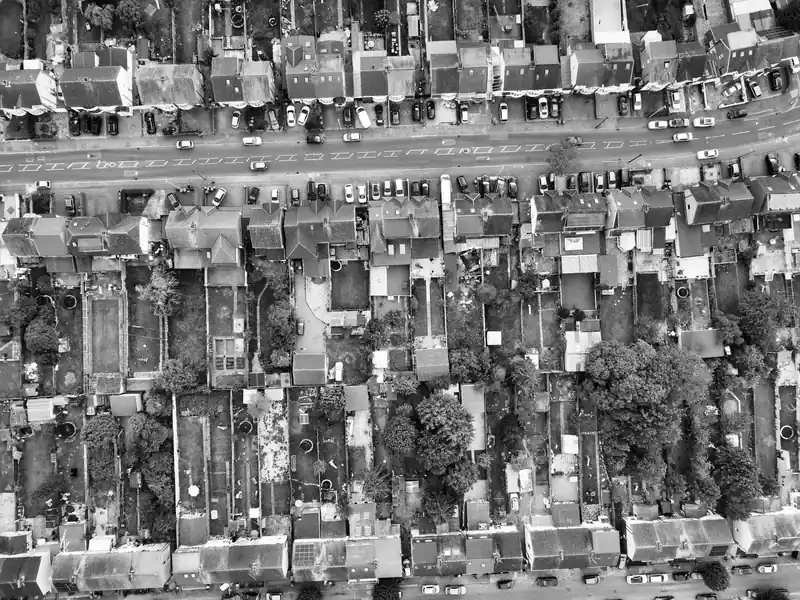
North of the town centre it looks different. The Victorian and Edwardian terraces of Thornton Heath, Norbury, South Norwood and Addiscombe rarely had space for a garage, so the sheets show up on coal stores, old outside toilets, lean-to workshops and the occasional garage at the bottom of a garden that backs onto a rear alley. Then there are the postwar estates such as New Addington and Fieldway, where rows of lock-up garages share a single court and, quite often, a single run of roof.
One quick sorting question before going further. If your garage roof is flat, has a timber deck and is covered in felt, it is not asbestos sheeting at all. That is an ordinary flat roof repair job and nothing below applies to it.
Is it cement sheet? Checking without a ladder
You can tell a lot from an upstairs back window and the zoom on your phone. Asbestos cement sheets are grey when new and weather to a dull, speckled grey-green, usually with patches of yellow and white lichen. They are thick, about 6mm, with big rounded corrugations, and the chipped corners and edges look more like stone or stiff biscuit than metal. Underneath, inside the garage, you’ll typically see hook bolts wrapped around the purlins with domed washers on top.

The things that rule it out are just as useful. Steel sheets are thin, ring when tapped and go rusty at the laps. Bitumen sheets, sold under names like Onduline, are soft and slightly floppy, and come in black, green or red. Plastic and polycarbonate let light through. A garage built or re-roofed after 2000 is very unlikely to have asbestos on it, though “the previous owner said it was replaced” is not the same as a receipt.
None of this proves anything either way. It tells you whether to spend money on a test, which is the next step.
Moss, gutters and a pressure washer: three jobs to leave alone
Croydon’s southern half is heavily wooded, and a garage roof under an oak or a sycamore in Purley or Kenley grows moss in thick cushions and fills its gutter every autumn. That is exactly when people reach for the wrong tools.
The pressure washer comes first on the list. Weathering has already loosened the top surface of an old cement sheet, and a jet blasts that surface off and sprays the slurry across your lawn, the patio and probably next door’s washing. HSE’s guidance on cleaning these roofs says high-pressure jetting is for exceptional circumstances only. The safe approach is to wet the moss and lift it off by hand with a scraper from a proper access platform, and only if it really has to go.
Walking on it is the second. HSE treats every asbestos cement roof as fragile, with no exceptions. Sheets that have sat out for fifty winters snap without warning, and the drop is onto a concrete floor or the car.
The third is drilling, screwing or cutting into it to fit a bracket, a light, an aerial or a new section of gutter. Power tools are the quickest way to turn a stable sheet into airborne dust, and an angle grinder is the worst of the lot. If a sheet is intact and you have no reason to touch it, leaving it where it is remains a perfectly sensible choice. If you or a tradesperson do need to work on one, HSE’s Asbestos essentials task sheets set out the method for each job, from gutter cleaning to taking a sheet off.
Getting a sample tested before anybody quotes
A test costs very little next to the job itself, and it changes how the work is priced, who can do it and where the waste can go. There are two ways to get one. A surveyor can visit, wet a corner of a sheet, take a small piece, seal the broken edge and send the sample off. Or you can buy a postal kit, take the sample yourself following its instructions, double-bag it and post it to the lab. Use a lab accredited by UKAS for asbestos analysis either way. Results usually come back within a few working days.

While you’re in the garage, look up. Some garages and outbuildings have flat boards fixed under the roof or lining the walls, and on older ones that board can be asbestos insulating board rather than cement sheet. Insulating board is softer, breaks up more easily and is much more hazardous, and HSE says only a licensed contractor should remove it. If anything inside looks like board, get it sampled at the same time.
Licensed, non-licensed or doing it yourself
Most work on asbestos cement can be done without an HSE licence. That doesn’t mean anyone can do it. The people doing non-licensed work still need training in asbestos and the right equipment, and they have to follow a set method: wet the sheets, unbolt them rather than smash them, lower them rather than drop them, and wrap them before they leave the roof. A contractor who plans to break the sheets up and throw them in a skip is the one to avoid.
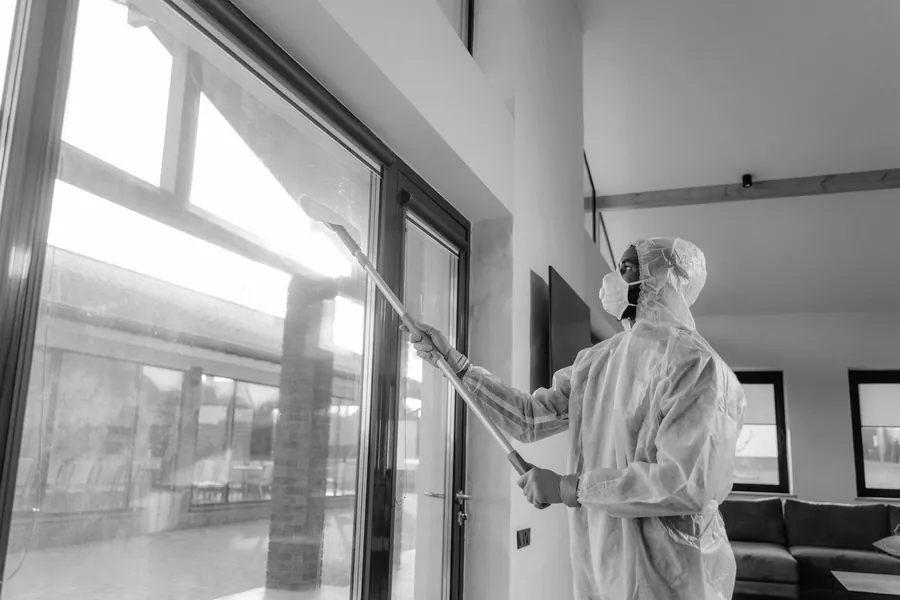
What about doing it yourself? The asbestos regulations are written around people working for a living, and HSE’s line for householders is simply that trained professionals should do it. Some people still take a small shed roof off themselves, and on a little lean-to that’s understandable. If you do, pick a still, damp day, tell the neighbours, wear a disposable coverall and an FFP3 mask, keep the sheets wet, cut the bolts with hand tools and keep every sheet whole. It’s a two-person job on anything bigger than a shed, and nobody should be standing on the sheets while they work.
If you hire someone, ask three things before you pay a deposit. Have their operatives had asbestos awareness and non-licensed work training, and can they show you the certificates? Are they a registered waste carrier? You can check on the Environment Agency’s public register in a couple of minutes. And where will the sheets go, with what paperwork? Hazardous waste a contractor takes away should come with a consignment note.
Disposing of an asbestos garage roof in Croydon
This is where Croydon differs from a lot of the country. Factory Lane, Fishers Farm and Purley Oaks all list asbestos as something they don’t accept, so there is no driving it to the tip yourself. Don’t put it in the black bin or a general builders’ skip either.
The council sends householders to the hazardous waste service run by the City of London Corporation, which collects for every London borough except Hillingdon. Croydon Council’s asbestos page explains the arrangement, and the details on the City of London’s hazardous waste collection page are the ones to plan around:
- The first 15 square metres of sheet are collected free, paid for by the council. Above that you get a quote, and you pay before the collection.
- You get one collection per rolling year, from your home address, and you’ll need to show recent council tax payments.
- Every sheet or piece has to be wrapped on its own in heavy-duty plastic and sealed with strong tape. The crew won’t test, dismantle or wrap anything for you.
- Broken pieces go in sealed builders’ rubble bags that one person can lift. The City’s page says seven bags; Croydon’s own page still says five half-filled ones, so check when you book.
- It can take up to ten working days from receiving your paperwork to arrange the pickup, and the phone line is voicemail only.
- Landlords, charities and businesses can’t use it.
That 15 square metre limit is tighter than it sounds. A single garage roof measuring about 2.6 by 5.5 metres comes out at roughly 14 to 17 square metres of sheet once you count the overlaps and the overhang, so it may land just under the limit or just over it. A double garage goes over every time.
Think about the route, too. A wrapped 2.4 metre sheet is an awkward carry for two people along a side passage, and the job is worse through a terraced house with no back access. Work out where the stack will sit before the first bolt comes out. If you hire a contractor, disposal normally goes on their bill rather than through the City scheme. Make sure it does, because household waste you hand to someone unregistered who then dumps it can still land the fine on you.
What goes back on, and what the job costs in Croydon
Once the old sheets are off, a single garage usually gets one of three roofs. Non-asbestos fibre cement sheets look almost identical to the old ones and sit on the same purlins, which suits anyone who wants the garage to look unchanged from the street. Box-profile steel is lighter and cheaper. Ask for an anti-condensation backing, or the underside will drip on the car every cold morning. And if the roof is nearly flat, a new timber deck with EPDM rubber or GRP on top turns it into a proper flat roof with a long life.

Paperwork is light. A detached garage under 30 square metres with no sleeping accommodation is normally exempt from building regulations, and re-roofing an outbuilding in a similar material rarely needs planning permission. The exception is a garage visible from the street in one of Croydon’s conservation areas. Check with the council before you change how it looks.
Typical 2026 prices for a single garage in Croydon, including VAT, are below. A double garage runs about 1.7 to 1.9 times the figures.
| Item | Typical cost |
|---|---|
| Postal test kit with UKAS lab analysis | £40 to £90 |
| Surveyor visit to sample the roof and any internal boards | £150 to £300 |
| Non-licensed removal of the cement sheets, wrapped and disposed of | £700 to £1,500 |
| Doing it yourself: coveralls, FFP3 masks, polythene, tape | £60 to £120 |
| New box-profile steel with anti-condensation backing | £1,200 to £2,200 |
| New non-asbestos fibre cement sheets | £1,400 to £2,500 |
| New timber deck with EPDM or GRP | £1,800 to £3,200 |
| Sealing coat on sound sheets left in place | £400 to £900 |
Back-garden access adds to most of these. If every sheet, purlin and roll of membrane has to go down a narrow passage or through the house, expect another few hundred pounds of labour, plus a council licence if the skip has to sit on the road.
Garage courts, rented lock-ups and selling a house with one
Shared garage blocks need more organising than a single garage. If you rent a lock-up from the council or a housing association, the roof isn’t yours to fix: report it to the landlord and leave it alone. If you own one garage in a privately owned row, the sheets often run across the party walls, so taking off your bit can expose the edge of next door’s. It’s worth getting the neighbours on side and using one contractor for the whole row. Remember too that the free collection comes from your home address, not the garage court round the corner, so sheets from a lock-up need a plan of their own. We wrote about New Addington’s estate housing and the asbestos cement used in that era in our guide to roofers in Sanderstead, Selsdon and New Addington.
Selling is the other moment these roofs come up. A buyer’s surveyor will mention an asbestos cement garage roof almost every time, and an unanswered question can turn into a chunk knocked off the offer. Having the lab result in a folder, along with either a removal quote or the consignment note from a removal you’ve already done, usually ends the conversation quickly. We cover the wider version of this in our post on selling a Croydon house with a roof problem.
Get a free quote for a new garage or outbuilding roof in Croydon
Frequently asked questions
Can I take asbestos garage roof sheets to the tip in Croydon?
No. Asbestos is on the list of things Croydon's reuse and recycling centres do not accept, and that covers all three sites: Factory Lane, Fishers Farm and Purley Oaks. Croydon households use the hazardous waste collection run by the City of London Corporation instead. It collects wrapped sheets and bagged pieces from your home address, and Croydon Council subsidises the first 15 square metres.
Is it legal to take an asbestos cement garage roof off myself?
The asbestos regulations are written for people doing the work as a job, and most work on asbestos cement doesn't need a licence. HSE strongly recommends using trained people all the same. If you do it yourself, wet the sheets, unbolt them rather than breaking them, wear a disposable coverall and an FFP3 mask, and wrap every sheet before it leaves the roof. Get the material tested first, and stop if anything inside the garage looks like insulating board, because that needs a licensed contractor.
How much of my garage roof will the free collection take?
The City of London's hazardous waste unit collects the first 15 square metres of wrapped asbestos sheet free of charge for Croydon residents, once per rolling year. A typical single garage comes out at roughly 14 to 17 square metres of sheet once overlaps and overhangs are counted, so it may land just under or just over. Anything above the limit is charged on a quote, and a double garage will almost always go over.
Will an asbestos garage roof stop me selling my house in Croydon?
Rarely. Buyers' surveyors flag asbestos cement garage roofs all the time, and lenders are used to them. What slows a sale down is not knowing. A lab result showing what the sheets are, plus either a removal quote or the paperwork from a removal already done, usually settles the question before it turns into a price negotiation.
Free roof survey and a fixed written quote
Anywhere in Croydon and the surrounding CR postcodes. No call-out fee.